Making a probe like this is not exactly revolutionary. Our goal is to build a robust unit, both physical and software wise. Experience has shown that developing a reliable datalogger from scratch is a process that can take months, if not years ('Good software takes 10 years. Get used to it') So we soon decided to cut short and use a Campbell datalogger as the core of the system. Campbell already gone through the ten year cycle and datalogging is their core business so these units are extremely reliable. Interfacing to sensors is very well documented and programming is relatively simple.
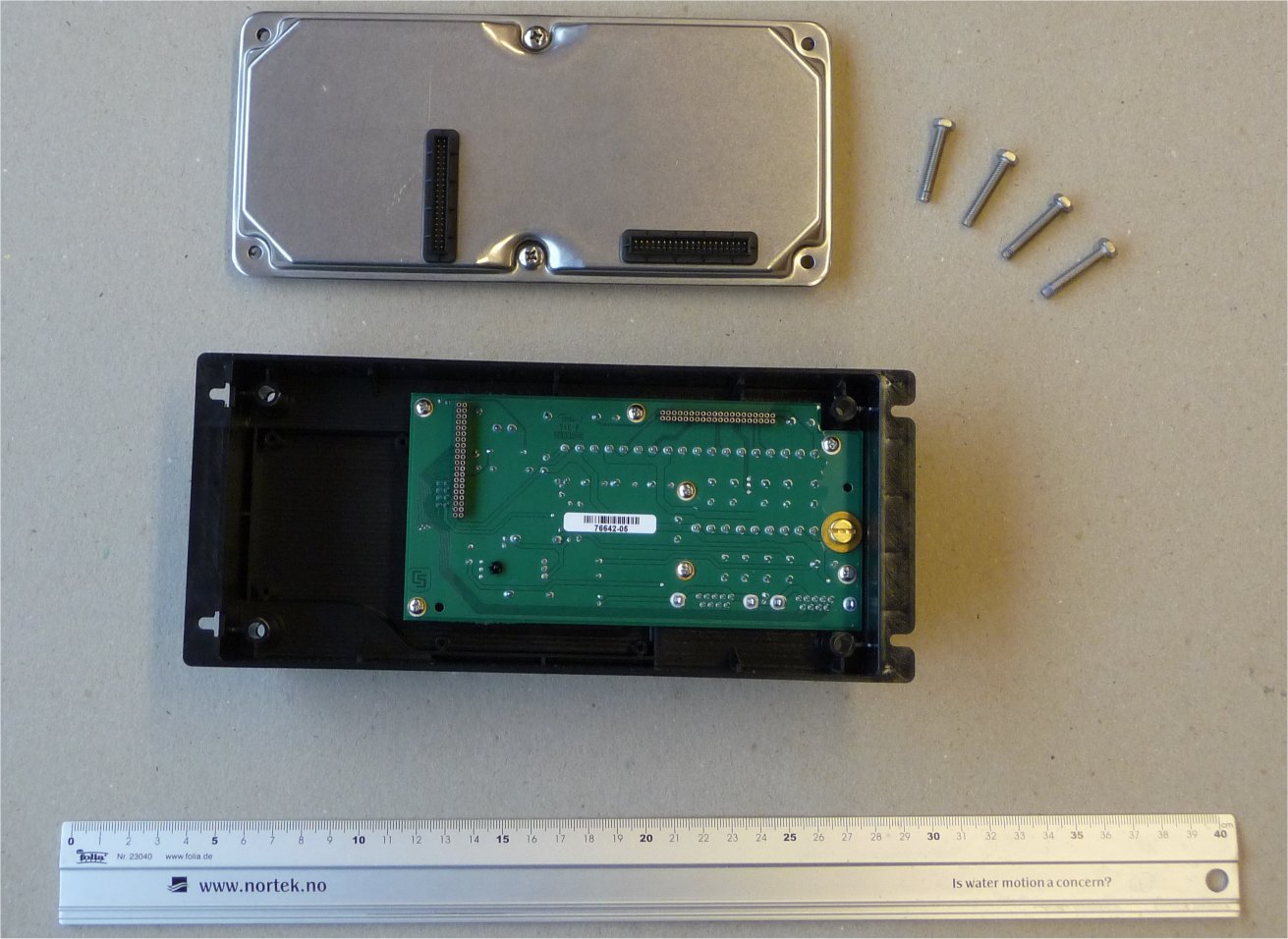
The only disadvantage is their size. The brick shaped wall mount housing is not very well suited for mounting in a tube. So we take it apart...
And then it's not too bad. The metal box is the actual logger and the PCB just contains the connectors, fuses and overvoltage protectors. These parts will fit in a 10 cm inner diameter tube which is a very acceptable size.
Obviously we benefit most from choosing a Campbell datalogger if we also use their sensors. Unfortunately not all of these are really suitable for use in extreme sea-conditions but they will do fine in fresh to brackish water of rivers harbours and estuaries. This settles our choice for the Conductivity, Temperature, pH and OBS sensors. Choosing a Dissolved Oxygen sensor is easy. We will use the InsiteIG optical DO sensor which has already proven itself in the Nortek Oxybox. Finally we will need a pressure sensor. The easiest solution is to use the same sensor as used in the all other Nortek current meters.This will require some additional electronics for the signal conditioning but we will need an additional PCB anyway for connections, power supply and some interfacing.
Nortek Multi Parameter Probe
Monday, 15 February 2010
Sunday, 10 January 2010
Nortek Multi Parameter Probe
When choosing a system for environmental monitoring at sea it is tempting to use the multi-function, lightweight multi parameter probes as commonly used in fresh water monitoring. Typical sensor suites like this are made by YSI, HydroLab or Eureka. When used in harsh environments however these instruments have shown to be just to fragile. Nortek therefore decided to try and develop a sensor suite that is more robust and able to withstand the harsh conditions at sea.
Requirements:
- Robust construction, able to withstand reasonable impact
- Low power
- Field replaceable sensors
- All sea water resistant materials
- Flexible communication options (RS-232, RS-485, MODBUS, SDI-12)
Requirements:
- Robust construction, able to withstand reasonable impact
- Low power
- Field replaceable sensors
- All sea water resistant materials
- Flexible communication options (RS-232, RS-485, MODBUS, SDI-12)
Subscribe to:
Posts (Atom)
